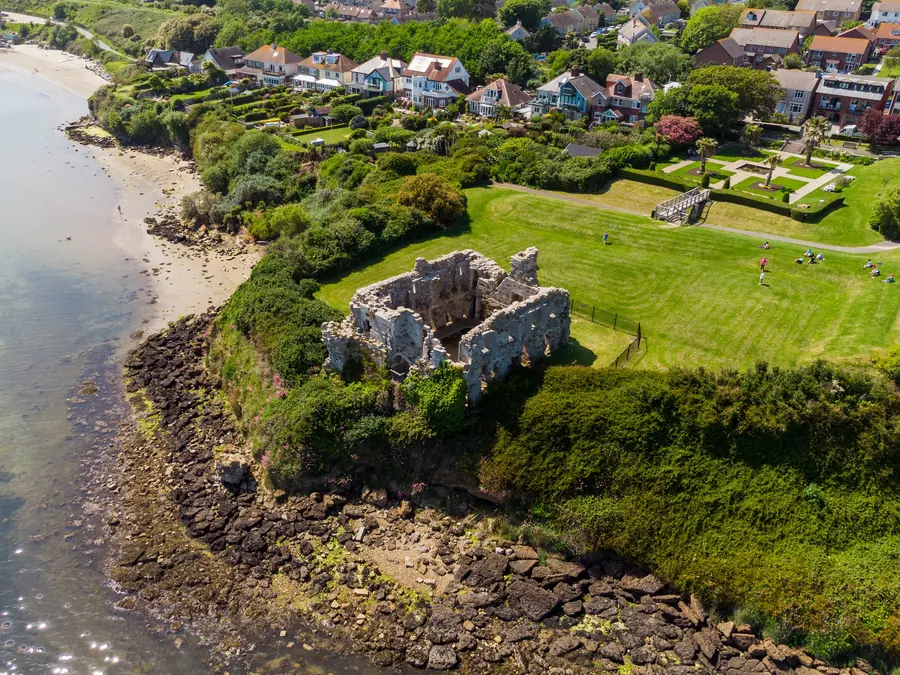
Sandsfoot Castle — historically Weymouth Castle — stands on a low cliff at Old Castle Road, two kilometres south of Weymouth town centre, looking across Portland Harbour to the Isle of Portland.
It was built for Henry VIII as part of the Device programme, completed by 1542 at a cost of £3,887, and it worked in partnership with Portland Castle on the far shore: two gun forts crossing fire over the Weymouth Bay anchorage between them.
It is free.
An octagonal gun platform projecting towards the sea, linked to a residential blockhouse behind it. Earthwork defences were added around the landward side, probably in 1623.
It saw service in the Civil War, held by Parliament and by Royalists in turn, survived the interregnum, and was withdrawn from military use in 1665 after the Restoration.
Erosion.
Sandsfoot was built on soft cliff, and the sea has been undermining it since the seventeenth century. The gun platform collapsed onto the beach, the blockhouse was quarried for stone, and by the nineteenth century what was left was a picturesque shell.
Portland Castle, built on hard limestone on a sheltered shore, survives complete. The two forts are a lesson in geology as much as in fortification.
The remains were consolidated and stabilised in a restoration project a little over a decade ago, which halted the loss.
Be clear about this before you go: the ruins are fenced and cannot be entered. You look at them from the garden, and several visitors note the fence with regret.
What you do get is:
Sandsfoot Gardens — a beautifully kept public garden immediately above the castle, with lawns, borders, benches and a kiosk for refreshments that visitors specifically praise.
The view — across Portland Harbour and its breakwaters to the Isle of Portland, and east along the Dorset coast towards St Alban’s Head.
A picnic spot as good as any on this coast, free, with somewhere to sit and something to look at.
The consistent verdict is that it is lovely, limited and worth the twenty minutes — a place to stop on a walk rather than a destination.
Sandsfoot is on the Rodwell Trail, a level walking and cycling route along the trackbed of the old Weymouth-to-Portland railway, which runs from the town out towards Ferrybridge and the start of Chesil Beach.
That makes the castle a natural stop on the walk south from Weymouth to Portland — which is the way most people encounter it, and the way it works best.
Free, open at all times.
Time: twenty to thirty minutes.
Parking: some parking just outside the gardens; limited.
Facilities: a kiosk in the gardens for refreshments; toilets.
Access: the gardens are largely level and manageable; the castle ruins are fenced and not accessible.
Getting there: Old Castle Road, about two kilometres from Weymouth town centre — twenty-five minutes’ walk, or on the Rodwell Trail.
The Rodwell Trail, level, running north to Weymouth and south to Ferrybridge.
Portland Castle, the sister fort, across the water — fifteen minutes by road.
Chesil Beach and the Fleet lagoon begin at Ferrybridge.
Weymouth Harbour is twenty minutes north.
No — they are fenced for safety and are viewed from the surrounding gardens.
Yes, free and open at all times.
Sandsfoot was built on soft eroding cliff and the gun platform collapsed into the sea; Portland Castle sits on hard limestone on a sheltered shore.
For twenty minutes on a walk, yes — the gardens, the view over Portland Harbour and the kiosk make it a good stop. Not as a destination in itself.
Along the Rodwell Trail, the level path on the old Weymouth–Portland railway line.