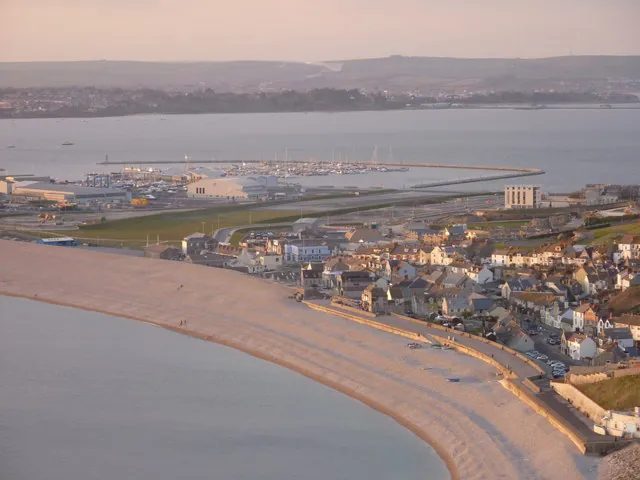
Chiswell is a small village at the southern end of Chesil Beach, in Underhill, on the Isle of Portland. It is the oldest settlement on the island, formerly known as Chesilton, and occupies the flat land close to sea level immediately behind the pebble bank — the single fact that has shaped everything about it. The small bay here is Chesil Cove, and the promenade and sea wall that defend the village are its most prominent feature.
You go from Weymouth for the cove and for a village that reads as a record of being repeatedly flooded. The gaps in the street frontages and the wall you walk along both exist because the sea came in. Chiswell has no attraction to queue for; what it has is a short, legible street where the storm history is still visible in the buildings.
The straight-line distance from Weymouth town centre is 5.5 km, and Wikipedia gives no road distance. The village was designated a conservation area, as part of Underhill, in 1976, as a place of special architectural and historic interest.
Construction of the sea wall began in 1958 and continued until 1965, running from the far end of Chesil Cove to the Cove House Inn. As well as reducing the flood risk and slowing coastal erosion, it gave Chiswell a promenade along its top, and that walk is the main reason to come down here rather than stay on the heights above.
The other thing to look for is on the west side of the main street, where the house frontages have gaps. Some are simply where buildings were lost. Others were built that way on purpose: they are called opes, a local term that survives in street names such as Big Ope, and they do two jobs at once — providing floodways for storm surges to run through, and giving access to small groups of buildings at the rear and out to the beach.
The settlement dates back to Roman times, when it was known as Coesl, and grew up as a fishing community alongside the pebble bank of Chesil Cove. A small tidal creek called the Mere once reached Chiswell but silted up as the village spread around it. Many of the stone and thatched cottages were originally built on the shingle of Chesil Beach itself.
Despite the exposure, it prospered. By the beginning of the 19th century Chiswell had become established as what Wikipedia calls a “burgeoning centre of trade and exchange”, and through that century it was the island’s largest settlement, lived in mainly by fishermen, quarrymen, traders and their families.
Flooding was a routine part of village life, and one incident stands apart. The Great Storm of 1824 struck Chiswell with full force: thirty residents died, eighty houses were destroyed and many more damaged, so extensively that the village never made a full recovery. Decline continued through the 20th century, and calls for sea defences went unanswered — the engineers Coode & Partners drew up plans in 1942, but there was no funding and nothing was built.
Even after the wall went up, the sea kept arriving. Two major storms, in December 1978 and February 1979, caused further devastation and led to more defences being installed between 1983 and 1986. In January 1990 Cyclone Daria overwhelmed the wall, caused extensive damage and temporarily closed access to and from the mainland. In January and February 2014, violent storms across southwest England flooded the village again, drawing national and international attention; a hole in the sea wall, the gabions and the promenade all had to be repaired, and the flood alleviation channel and the beach itself had to be reprofiled for future floods.
Most of the buildings are strictly residential. Some are given over to tourism as bed and breakfasts and holiday lets, and there are commercial premises including public houses and restaurants. The former United Reformed Church and its manse remain a focal point on the main street, although it closed to congregations in 2009. A number of the buildings are Grade Listed by Historic England, and some stand at least in part from the 1600s.
The A354 runs northbound through the village, and at the street’s widest point the village square now serves as a car parking area. East of the main street is a stretch of open, higher ground that acts as a buffer between Chiswell and the adjoining village of Fortuneswell, which occupies the steeper hills and streets above.
The one thing here that is deliberately open to visitors is the Chiswell Walled Garden, created between 2001 and 2006 by the Chiswell Community Trust inside the walls of an old house that remains a ruin, and maintained by Trust volunteers.
There are no visitor reviews for Chiswell itself; the village is not a rated attraction. The two rated places listed near it are both further onto the Isle of Portland, so treat them as a second stop rather than part of the same walk.
Portland Castle holds 4.4 from 2,211 Google reviews. Tout Quarry Sculpture Park and Nature Reserve holds 4.6 from 617, and reviewers there make the same two points repeatedly: it costs nothing, and the ground is rough. A visitor in June 2026 wrote, “What a great find. Complete free and rather interesting. Very peaceful.” Another that month gave the practical version — the free car park is gravel, and “It can be rocky under foot,so trainers or walking shoes are a must.”
Chiswell sits on the road onto the island. At its northern entrance is Victoria Square, a 19th-century development that now forms a roundabout on the main A354 onto Portland, and the A354 continues northbound through the village street.
Buses for Portland leave from the King’s Statue stops in Weymouth, a short walk from the railway station, and include the seasonal open-top bus 11 to Portland Bill. Nothing in the sources here names a stop at Chiswell itself, so check the route before relying on it.
By bike, Weymouth is on National Cycle Network Route 26, an 85.9-mile signed route from Portishead that ends at the Isle of Portland. The Beryl e-bike scheme covers Dorchester, Weymouth and Portland, and Weymouth Bike Hire, 1.5 km from the town centre, also covers Portland. If you drive, the village square is the obvious target, and it is only as wide as one street.
The village and what is around it, at walking scale.
Open any of them in Google Maps for directions and current opening.
Attractions, prices and availability in Weymouth
These come from GetYourGuide's booking widget, which sets their cookies in your browser. Consent to load it and see the attractions and prices.
Background on Chiswell draws on its Wikipedia article, text there being available under CC BY-SA 4.0.