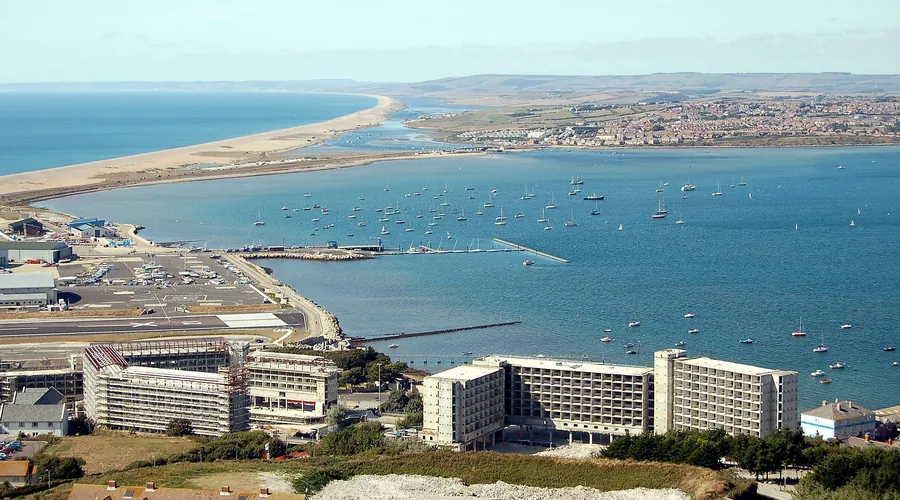
Castletown is a small village in Underhill on the Isle of Portland, on the shores of Portland Harbour and close to Fortuneswell. It has a sandy beach, a Tudor gun fort, and a dockside from which American troops embarked for Normandy. It is small: one main road, a pier, and a run of hotels and pubs largely established for the navy personnel who once came off the ships.
The reason to come out from Weymouth is that four centuries of defending the same anchorage sit within a few minutes’ walk of each other — Portland Castle, and the Castletown D-Day Centre, in the buildings from which the invasion of Europe was loaded. Castletown lies 4.9 km from Weymouth in a straight line; Wikipedia gives no road distance for the village.
Like the rest of Portland’s settlements it is a conservation area, a place of special architectural and historic interest: Underhill, which takes Castletown in, was designated in 1976, with boundary extensions in 1997 and 2000.
Wikipedia’s article on the village credits Henry VII with selecting the Castletown area for the castle during the 16th century. Visitors give a later account: one in July 2026 wrote that it was “Built between 1539 and 1541 on the orders of Henry VIII, it formed part of the king’s nationwide coastal defense program, known as the Device Forts, and was designed to protect the important anchorage of Portland Roads from potential invasion by France and the Holy Roman Empire.”
It is Grade I listed, one of only three Grade I listed buildings on Portland, and in October 1981 was scheduled under the Ancient Monuments and Archaeological Areas Act 1979. It carries 4.4 from 2,211 Google reviews. Expect a fort rather than turrets and a keep — a visitor in July 2026 put it plainly: “Technically, it is not a castle, but a Gun Fort.”
The Captain’s House next door is Grade II* listed, along with the gateway and curtain wall to its south east; a War Department and Admiralty boundary marker about 23 metres (75 ft) south of the house’s entrance has been Grade II listed since May 1993.
In 1944 Portland’s harbour was commissioned as USNAAB Portland-Weymouth and became a major embarkation point for American troops during D-Day, with soldiers and vehicles passing through Castletown. The Castletown D-Day Centre occupies the old Admiralty Buildings on the dockside and covers that role with a collection of wartime artefacts.
It is the best-reviewed place the research lists here, 4.8 from 1,026 Google reviews, and reviewers single out how much of it can be touched. A visitor in July 2026 wrote that “80%+ of the exhibits are hands on including experiences like operating an anti-aircraft battery, sounding an original air raid siren, and climbing into an actual tank.” Another, also in July 2026, had arrived by sea: “Probably the highlight of my cruise.” Portland Port Cruise Ship Dock, 4.4 from 211 Google reviews, is at the end of the road.
The centre was itself part of a regeneration plan: proposals for Castletown revealed in June 2015 named a “scuba diving tourist facility, an American themed D-Day attraction and museum”.
Castletown began as the place where fishermen launched their boats, and grew during the 19th century with the construction of Portland Harbour’s breakwaters and the establishment of the naval base. Its other trade was stone: the Merchant’s Railway, operational from 1826 to 1939, brought stone down from the quarries at Tophill to Castletown’s pier for shipping, in the era when stone travelled by sea. The Stone Pier is now used mainly for boat maintenance, and Castletown Pier has been under redevelopment as “Crabbers Wharf” since work began in 2015.
The research also lists Tout Quarry Sculpture Park and Nature Reserve among the places to see from the village, 4.6 from 617 Google reviews — carvings set along the paths of a worked-out quarry, with no charge to walk it. A visitor in June 2026 called it “Complete free and rather interesting. Very peaceful.” Another that month gave the practical version: the approach “Takes you to an industrial estate”, the free car park “is to the right on gravel”, and once you are walking, “It can be rocky under foot”.
Being the gateway to the naval base made Castletown a thriving commercial area; a one-sided terrace had formed by 1864, with businesses and homes alongside. Defence spending cuts in the early 1990s then put the base on the closure list, and the Royal Navy’s departure was forecast to bring economic disaster. The navy left in 1995, Castletown lost the majority of its income, and the businesses went one by one.
The evidence stands on the hillside south of the main road: two large multi-storey blocks set into the slope. Known as the Hardy Complex and built in the late 1980s and early 1990s as accommodation for Royal Navy personnel, they were abandoned less than 15 years later and stripped back to their concrete frames in 2004-05. The right-hand block, renamed Ocean Views, was rebuilt from 2007, and many of its apartments housed visiting foreign sailing teams for the 2012 Olympic sailing events in Portland Harbour. The left block remains derelict.
Other buildings were repurposed. The Osprey Leisure Centre, a private Royal Navy facility in the 1980s under the name Boscawen Centre, opened to the public in May 2007, and Portland Community Hospital served the base as a Royal Naval Hospital until it was handed to the NHS in 1957. The small beach is close to the entrance of Portland Port, and the Weymouth and Portland National Sailing Academy is nearby.
Wikipedia states no road distance for the village, so the 4.9 km straight line understates the drive. The transport notes in this research record no bus or train serving Castletown: no scheduled service is established here, so plan on driving, cycling or walking rather than assuming a timetable.
Parking attaches to the individual sites, not the village. A visitor in July 2026 confirmed of the fort: “There is a car park for the castle visitors.” Tout Quarry has its own free gravel car park.
Some visitors arrive without a car at all, off cruise ships berthed at Portland Port. The road through the village runs out at the port entrance, where the former Dockyard Police Station stands — Grade II listed, and originally a railway station.
The village and what is around it, at walking scale.
Open any of them in Google Maps for directions and current opening.
Attractions, prices and availability in Weymouth
These come from GetYourGuide's booking widget, which sets their cookies in your browser. Consent to load it and see the attractions and prices.
Background on Castletown draws on its Wikipedia article, text there being available under CC BY-SA 4.0.