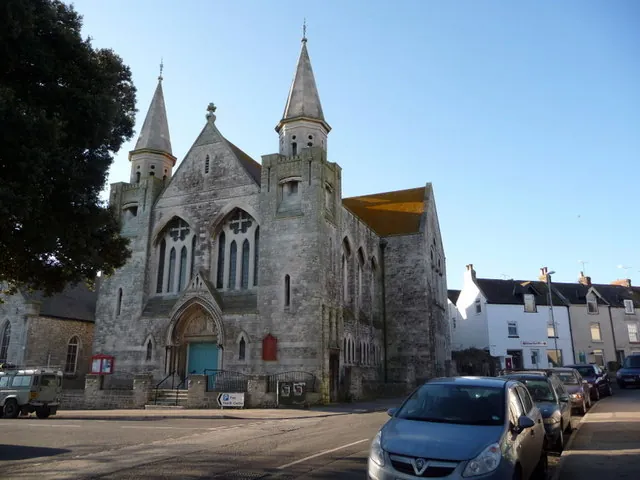
Easton is a village at Tophill, in the middle of the Isle of Portland, and it is the island’s inland town rather than one of its coastal set-pieces. There is no beach and no harbour. What there is: a square that held the village pond until the eighteenth century, shops and pubs around it, three churches, a small park, quarries on every side, and, along with Fortuneswell, the bulk of Portland’s day-to-day activity.
That is the reason to come out from Weymouth. The shoreline villages give you the water; Easton shows what the island did for a living, and it holds the island’s museum at Wakeham and the parish church at the far end of Reforne. The whole village is a conservation area, as Portland’s settlements all are, designated for special architectural and historic interest — Easton, Wakeham and Reforne pre-1974, with the Straits included.
The straight-line distance from Weymouth is 7.5 km. Wikipedia gives no road distance, so the straight line understates the journey.
Easton grew around a natural watercourse and a set of springs, with indications of medieval inhabitants. The village pond stood at Easton Square, where a well head and pump went in during 1775. The square remained barren ground long after that; in 1904 it was made into Easton Gardens, and the clock tower there was completed in 1907 and is Grade II listed. The gardens hold 4.6 from 56 Google reviews, too small a sample to lean on.
Around it are shops, a shopping arcade and pubs, and in early 2011 a Tesco opened here, Portland’s first major supermarket. Reforne, the western arm of the village, has St George’s Centre — a school when it opened in 1857, now a community centre used for local events — and The George Inn, one of the oldest inhabited buildings on the island and Grade II listed since May 1993.
White Stones Art Cafe, at 4.8 from 529 Google reviews, carries the highest rating of anything the research names in the village, and reviewers keep returning to the garden behind it. A visitor in July 2026 wrote, “The atmosphere in the garden is perfect.”
Portland Museum sits at Wakeham, close to Church Ope Cove. Founded by Marie Stopes, it opened in 1930 and carries 4.7 from 249 Google reviews. What it covers, in the words of a visitor in June 2026: “Lot’s of fantastic information and artifacts, from folklore, shipwrecks, St Andrew’s, the Mills, fossils and more.” The letters between Marie Stopes and Thomas Hardy are among the exhibits.
It is a small place, and the reviews say so: a visitor in July 2026 admired “An absolutely beautiful thatched cottage from the outside” but added that “it’s not got much room inside”, and advised being “mindful of the opening times”. There is a garden at the back with seats and shade.
Below the museum the ground falls to the sea, to what a visitor in July 2026 called “the ruins of Rufus Castle and St. Andrew’s Church on the cliff”. Rufus Castle holds 4.4 from 182 Google reviews.
The village is ringed by quarries, working and abandoned, though Easton itself grew out of farming rather than stone: Wikipedia is explicit that it developed through Tophill’s prime industry of agriculture.
The one you can walk into is Tout Quarry Sculpture Park and Nature Reserve, where carvings have been cut into the rock of a quarry no longer worked. It holds 4.6 from 617 Google reviews, costs nothing, and rewards slow looking: a visitor in June 2026 advised, “Keep an eye out for the hidden carvings as you go around. Some are a little over grown”.
Other industrial fabric survives. At Easton Lane is a lime kiln, Grade II listed in November 1984 when it stood abandoned and in poor condition; it lay in ruin for decades and by 2002 had become a residence and craft workshop. Opposite it is a second, larger and more complete, and not listed at all. South of the village, near Weston, are the two Portland Windmills, disused stone towers dating from as early as 1608 and the only historic windmill remains left in Dorset.
By 1782 Easton was the island’s second largest settlement; its first school, Maister’s School, had opened in the Straits in 1720. St George’s Church was built at Reforne between 1754 and 1766 as Portland’s parish church, replacing St Andrew’s on the cliff. It was designated Grade I in January 1951, one of three buildings on Portland to carry that grade.
The village’s worst day came in 1803. A press gang arrived at Easton Square to force Portland men into naval service and was met by a crowd gathered to stop them. One man was taken; when the crowd tried to free him the captain fired, and his marines opened fire too. Three people were killed and two wounded, one of whom, Mary Way, later died. It is remembered as the Easton Massacre.
From the 1840s Portland’s population rose sharply, Easton expanded and became more urban, and the hamlets of Reforne and Wakeham merged into it. The churches followed: Easton Methodist Church, dated 1906 and opened in September 1907, Grade II* listed since May 1993, and All Saints Church in the Straits, built between 1914 and 1917, which took over as parish church for Tophill.
Easton once had its own railway. The Easton and Church Hope Railway carried the Weymouth and Portland line up to the village; the station opened to goods trains on 1 October 1900 and to the public on 1 September 1902, closed to passengers in 1952 and to goods in 1965, and was demolished in 1970. A residential home stands on the site.
The transport notes in this research name no bus stop at Easton, so no service to the village is established here — check a current timetable rather than assume one. Services onto the island leave Weymouth from the King’s Statue stops, a short walk from the railway station, the seasonal open-top 11 among them, though the destination the research gives for that one is Portland Bill.
By bike, National Cycle Network Route 26 runs 85.9 signed miles from Portishead to the Isle of Portland. Weymouth Bike Hire, 1.5 km from the town centre, covers Portland, as does the Beryl e-bike scheme. If you drive, the square is the centre of things, and Tout Quarry has a free gravel car park of its own.
The village and what is around it, at walking scale.
Open any of them in Google Maps for directions and current opening.
Attractions, prices and availability in Weymouth
These come from GetYourGuide's booking widget, which sets their cookies in your browser. Consent to load it and see the attractions and prices.
Background on Easton draws on its Wikipedia article, text there being available under CC BY-SA 4.0.