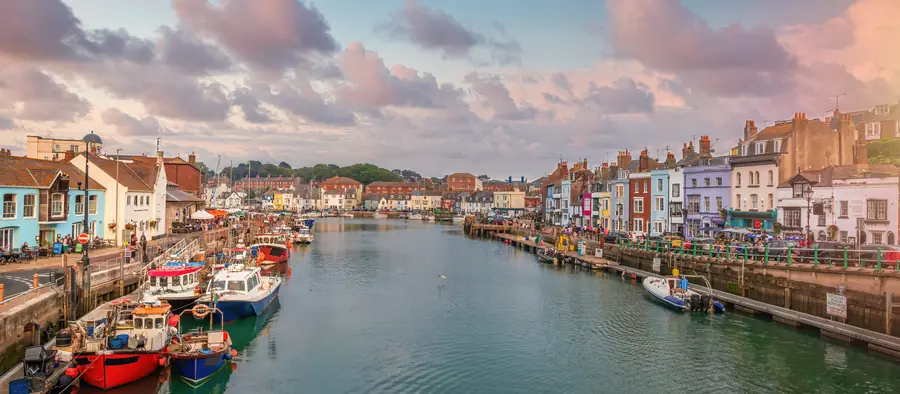
Weymouth Harbour — the Old Harbour — is a narrow tidal inlet running inland from the sea between the town and the Nothe peninsula, and it has a seventeenth-century waterfront.
It is the older half of Weymouth. The beach and the Esplanade are Georgian resort; the harbour is the working port that came first, and it is still a working port.
Custom House Quay on the north side and Trinity Road on the south, facing each other across water perhaps sixty metres wide, lined with buildings from the seventeenth century onwards in a jumble of periods, painted in different colours.
Fishing boats, yachts, sailing barges and the occasional tall ship moored along both quays, at eye level with the pubs.
The Town Bridge, a lifting bascule bridge of 1930, which opens on the hour and half-hour in season to let masted vessels in and out — worth timing, because the whole harbour stops to watch.
Visitors regularly describe it as the most beautiful harbour in the country, and while that is a large claim, the combination of period buildings, working boats and the water at street level is genuinely rare.
A small passenger ferry rowed across the harbour between the two quays, in operation since the 1920s and one of the last of its kind in Britain.
It costs very little, takes two minutes, and it saves a walk round to the bridge. It is also one of the more delightful things you can do in England for the price of a coffee.
Note: it runs seasonally and in reasonable weather.
The harbour is where Weymouth eats.
Pubs along both quays, several very old — the Ship Inn, the Old Rooms and others.
Seafood — the fishing fleet lands here, and there are stalls and restaurants selling what came off the boats.
Cafés and restaurants the length of both sides, most with outdoor tables on the quay.
Weymouth and Melcombe Regis, on the north side, were separate boroughs and rivals for centuries before being merged by Elizabeth I in 1571.
The Black Death entered England here. In June 1348 a ship from Gascony docked at Melcombe Regis carrying plague, and within two years it had killed perhaps a third to a half of the population of England. There is a small memorial on the harbourside.
In 1944 the harbour was a D-Day embarkation point — around half a million American troops left from Weymouth and Portland for Omaha Beach, and there are memorials on the quay.
Free, open at all times.
Time: an hour to walk round both quays; longer with lunch.
Access: the quays are level and surfaced and the harbour is one of the more accessible attractions in the town — the ferry in particular is praised by visitors with mobility difficulties for making the crossing easy.
Parking: town car parks; the harbour itself is tight.
Boats: trips run from the harbour to Portland, along the Jurassic Coast and out to sea.
Nothe Fort and Nothe Gardens on the headland at the harbour mouth, ten minutes’ walk.
Weymouth Beach and the Esplanade, five minutes north.
Brewers Quay and the old brewery buildings on the south side.
Hope Square, behind the south quay, with pubs and a good square.
Yes — fishing boats still land here, alongside yachts and visiting vessels.
A small passenger ferry rowed across the harbour between the quays, running since the 1920s and one of the last of its kind. Seasonal and weather-dependent.
On the hour and half-hour in season, to let masted vessels through.
Both quays are lined with pubs, seafood restaurants and cafés, most with tables on the waterfront.
Yes — the quays are level and surfaced, and the ferry makes the crossing easy.