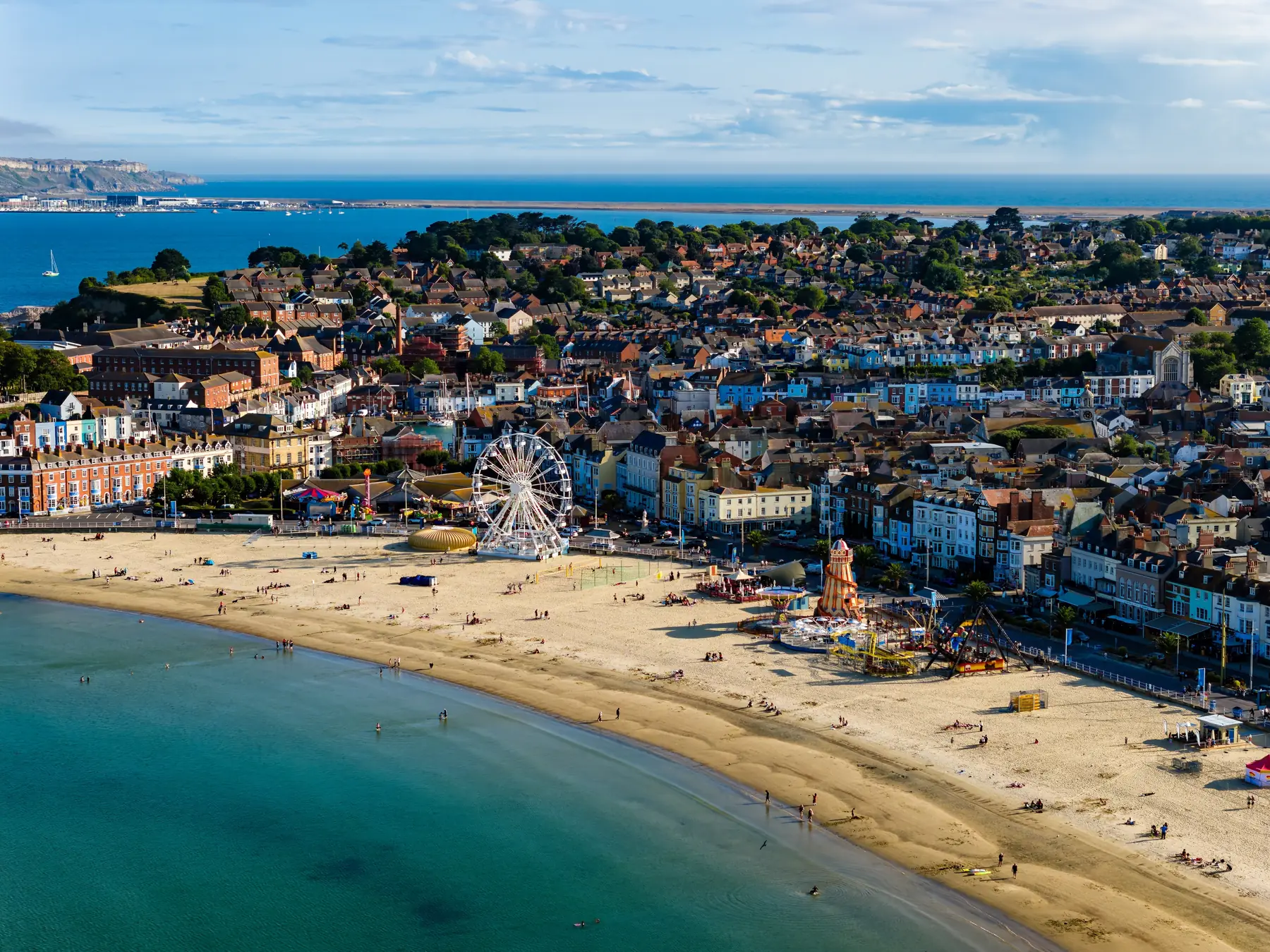
Weymouth sits roughly halfway along the Jurassic Coast, ninety-five miles of coastline from Exmouth to Studland that is England’s only natural World Heritage Site, and it makes an excellent base for exploring it. Lulworth and Durdle Door are half an hour east, Lyme Regis an hour west, Portland is on the doorstep, and inland Dorset — Hardy country, hillforts and market towns — begins immediately behind.
Five kilometres, over the causeway, and a completely different landscape: a limestone island four miles long, quarried for centuries for the stone that built St Paul’s Cathedral and much of London.
Portland Bill at the southern tip has a red and white lighthouse, the Pulpit Rock stack, and offshore the Portland Race, one of the most violent tidal races in Britain, which on a spring tide is visibly a standing wall of water.
Portland Castle, one of Henry VIII’s forts of 1539–41, sits at Castletown by the harbour. Tout Quarry is a disused quarry turned sculpture park, free and strange. Church Ope Cove and Rufus Castle are on the eastern side. Portland Harbour was the 2012 Olympic sailing venue and the academy is still there.
The 501 open-top bus runs from Weymouth to the Bill in season, which is one of the better bus rides in England.
Chesil Beach runs eighteen miles north-west from Portland to West Bay, with the Fleet lagoon behind it. There is a visitor centre at Ferrybridge and the whole thing is a national nature reserve.
Abbotsbury, twelve kilometres west, is worth a day on its own: the Swannery, the only managed colony of nesting mute swans in the world, with several hundred birds and cygnets in May and June; the Subtropical Gardens; a children’s farm; St Catherine’s Chapel on the hill; and the great tithe barn.
Beyond it, West Bay with its orange cliffs, Bridport with its market and its food scene, Lyme Regis with the Cobb and the fossil beaches, and Charmouth, which is the best fossil-hunting beach on the coast.
Osmington, six kilometres east, has the White Horse — George III on horseback, cut into the chalk in 1808.
Lulworth Cove, twenty-five minutes east, is a near-circular bay eaten out of the rock, with Durdle Door — the limestone arch — over the hill from it. Both are extremely busy in summer; go early or late, and be aware that the walk to Durdle Door is steep.
Tyneham, further east, is a village requisitioned by the Army in 1943 and never returned — the church and school are preserved and the rest is ruins. It opens when the Lulworth range is not firing, which is most weekends and holidays.
Corfe Castle, fifty kilometres east, is a ruined castle on a gap in the Purbeck ridge, dramatically slighted in the Civil War, with a village below and the Swanage Railway running steam trains to the coast.
Swanage, Studland and Old Harry Rocks are at the far end.
Dorchester, twelve kilometres north and ten minutes by train, is the county town — Roman Durnovaria, and Thomas Hardy’s Casterbridge. The Dorset Museum and Art Gallery, the Tutankhamun Exhibition, the Dinosaur Museum, the Keep Military Museum and Maumbury Rings, a Neolithic henge the Romans made into an amphitheatre, are all within a few streets.
Maiden Castle, on the edge of the town, is the largest Iron Age hillfort in Britain and free.
Athelhampton House, seventeen kilometres north-east, is a fifteenth-century manor with formal gardens.
Hardy’s Cottage at Higher Bockhampton and Max Gate, the house he built himself, are both National Trust and both near Dorchester.
The Tank Museum at Bovington, eighteen kilometres away, holds the finest collection of armoured vehicles in the world and is one of the highest-rated museums in Britain. Entirely indoors, most of a day, and worth the trip whatever you think of tanks.
Monkey World, a primate rescue centre, is next door and is the family alternative.
Clouds Hill, T. E. Lawrence’s cottage, is nearby and is National Trust.
Weymouth is the terminus of two railway lines. South Western Railway runs to Dorchester South, Poole, Bournemouth, Southampton and London Waterloo, taking around three hours to London. The Heart of Wessex line runs north through Dorchester West, Yeovil, Castle Cary — for Glastonbury and Bath connections — to Bristol.
Buses do the rest. The 501 is the open-top service to Portland Bill in season. The X53 runs west along the Jurassic Coast towards Bridport, Lyme Regis and Axminster. The X54 runs east to Wool — for Bovington and Monkey World — and on to Wareham and Poole.
Between them, Portland, Dorchester, Bovington, Lulworth and the western coast are all reachable without driving. Our getting here page has more.
The Portland day. Over the causeway to Portland Castle at Castletown, on to Tout Quarry for the sculptures, and down to the Bill for the lighthouse and the Race. Back along the eastern side for Church Ope Cove. Fifteen kilometres of driving, or the whole thing on the open-top 501 bus.
The Purbeck day. East to Lulworth Cove and Durdle Door in the morning — early, before the car parks fill — then on to Corfe Castle for the ruin and the village, with the Swanage Railway if there is time. Around ninety minutes of driving in total.
The west Dorset day. Along the coast road to Abbotsbury for the Swannery and the subtropical gardens, on to West Bay for the cliffs and Bridport for its market, and back over the hills. Slower roads and a good deal quieter than the Purbeck side.
The A35 and A354 are the arteries and both queue in summer. The genuine pinch points are Lulworth and Durdle Door, where the car park fills by mid-morning from Easter onwards and the approach lanes back up, and Abbotsbury on Swannery days.
Going early solves most of it. So does the X53 and X54 bus network along the coast, and the train to Dorchester, Wool and Poole — which between them reach a surprising number of these destinations.
Portland and the Bill for a half day; Lulworth and Durdle Door for the Jurassic Coast set-pieces; the Tank Museum if it rains.
About twenty-five minutes east by road to the Lulworth car park, then a steep fifteen-minute walk over the hill.
Yes, on the X53 along the Jurassic Coast, though it takes well over an hour.
Charmouth and Lyme Regis, an hour west — the beaches there are the classic ammonite grounds.
Yes. The Bill, the quarries, the sculpture park, the castle and the coast path round the island easily fill one.