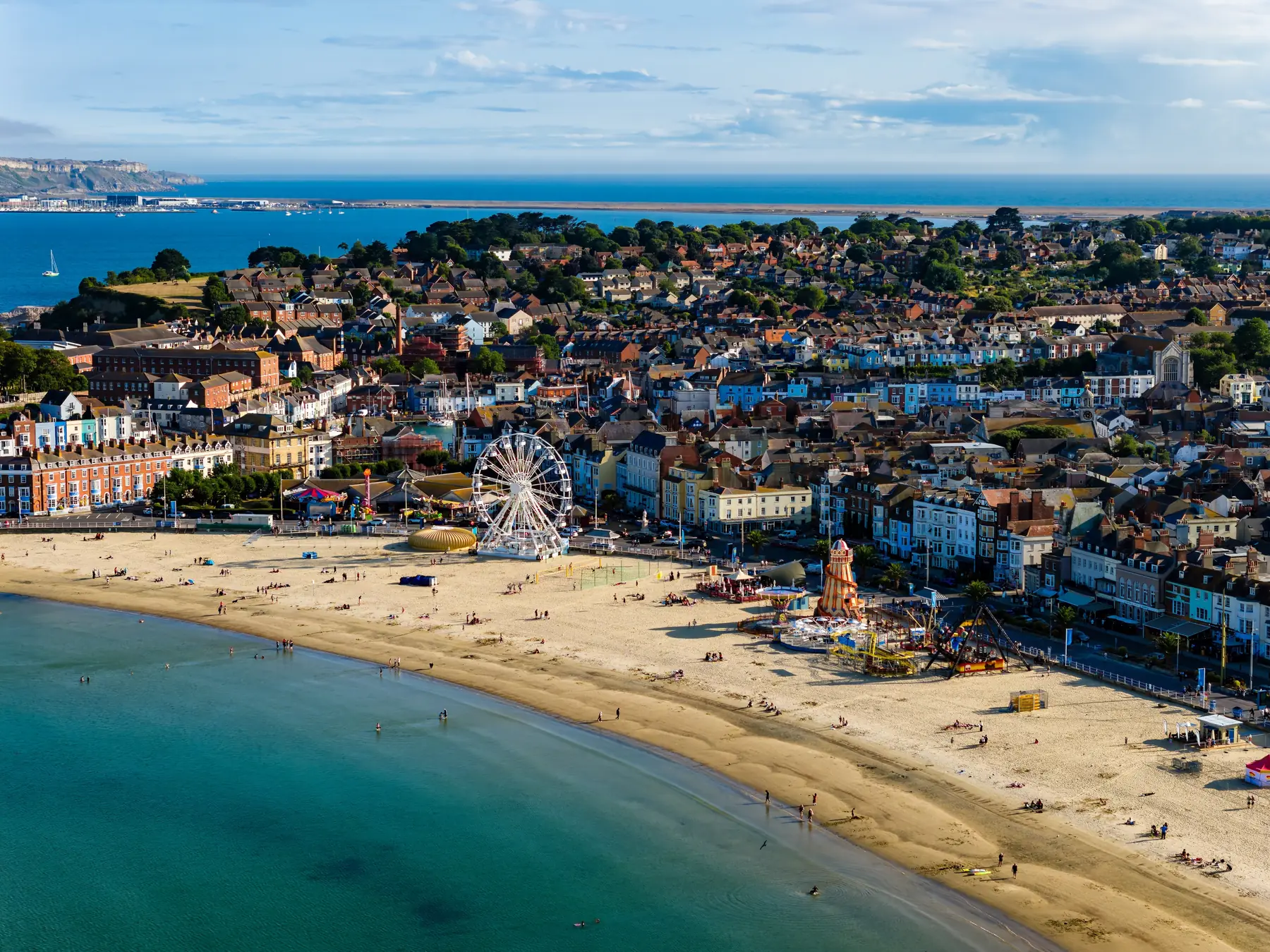
Weymouth has the best family beach on the south coast and it is not a close contest. A wide arc of fine sand, gently shelving into a sheltered bay, with a Georgian esplanade behind it, donkey rides, Punch and Judy and sand that is good enough for professional sculpting.
Around it sits a town that has been entertaining families since George III started coming here in 1789, and a ring of attractions from a Victorian fort to the best tank museum in the world.
Weymouth Beach is the reason to come. It curves for over a kilometre in front of the Esplanade, the sand is fine and the slope is gentle, and because the bay is sheltered the water is calm and shallow a long way out. Lifeguards patrol in season.
It also has the full traditional apparatus: donkey rides, Punch and Judy — performed here since the nineteenth century — deckchairs, pedalos, trampolines and a beach volleyball area. And the sand sculpture tradition, which has been going on this beach for over a century.
Bowleaze Cove, three kilometres east, is quieter with a funfair behind it. Portland’s Church Ope Cove is pebbly and dramatic.
At Lodmoor, two kilometres from the centre. A sizeable aquarium with an ocean tunnel, sharks, rays, penguins, otters, seals and a turtle sanctuary, plus outdoor splash areas. Half a day, and the town’s main wet-weather attraction.
On the headland above the harbour: a Victorian fort of the 1860s with ramparts, gun emplacements, underground passages and tunnels, and a lot of military hardware. It is run largely by volunteers, it has a good children’s trail and events through the holidays, and the views over the harbour and out to Portland are excellent.
The tunnels are the bit children remember. See our Nothe Fort page.
At Lodmoor. A sand sculpture park with large themed sculptures and a chance to have a go yourself. It is entirely dependent on the sand staying up, which it does under cover, and it works well for younger children.
The strip behind the beach at the eastern end, holding SEA LIFE, Sandworld, pirate-themed adventure golf, a miniature railway, a play area and the RSPB reserve. It is where families end up on a day that is not a beach day.
The Old Harbour with its lifting bridge, fishing boats and quayside is free entertainment. Crabbing off the quay is a Weymouth institution — lines and bait are sold everywhere along it — and it will absorb a child for a surprisingly long time.
Boats leave the harbour for coastal cruises, trips to Portland, RIB rides for older children, mackerel fishing in summer and — most usefully — a ferry across the harbour which is short, cheap and enjoyable.
Moonfleet Adventure Sailing and the sailing academy at Portland run sessions for children; Portland Harbour was the 2012 Olympic sailing venue and the facilities are still there.
Eighteen kilometres north-east at Bovington. It holds one of the finest collections of armoured vehicles in the world — several hundred tanks from the First World War to the present, including a working Tiger — with a large indoor space, live displays in season, and an outdoor arena.
It is entirely indoors, it takes most of a day, and it is one of the highest-rated museums in Britain. Older children and adults find it genuinely gripping. See our Tank Museum page.
Portland Castle, five kilometres south, is one of Henry VIII’s artillery forts of 1539–41, well preserved, with a Tudor gun room, a garden and views over the harbour.
Sandsfoot Castle, on the Rodwell Trail, is its ruined twin — free, small and in a public garden.
Maiden Castle, twelve kilometres north, is the largest Iron Age hillfort in Britain: enormous concentric ramparts on a hilltop, free, open and impossible to take in from ground level. Children run about on it happily for an hour.
Abbotsbury, twelve kilometres west, has a swannery — the only managed colony of nesting mute swans in the world, with hundreds of birds and, in May and June, cygnets — plus subtropical gardens and a children’s farm.
Lulworth Cove and Durdle Door, twenty-five minutes east, are the Jurassic Coast set-pieces. The walk from the car park to Durdle Door is steep but short.
Monkey World and the Dinosaur Museum at Dorchester fill in.
The Tank Museum, SEA LIFE and Sandworld are the three big indoor options, and Nothe Fort’s tunnels and casemates give a good deal of shelter. Dorchester, twelve kilometres north, has the Dorset Museum, the Tutankhamun Exhibition and the Dinosaur Museum in one small town. Our wet weather guide has more.
Getting here. Weymouth is the terminus of the line from London Waterloo via Bournemouth and Poole, and of the Heart of Wessex line from Bristol and Bath. The station is a few minutes from the beach.
Parking is on the edges — the Esplanade and harbour car parks fill early in summer. There is a park and ride.
The beach shelves gently, which is the single best thing about it with small children, and the bay is sheltered from the prevailing wind.
Tides. The beach is large at all states, unlike most on this coast.
A beach day. The beach in the morning while the tide is out and the sand is at its biggest, with donkeys, Punch and Judy and the sculptors going on around you. Fish and chips on the Esplanade. Afternoon crabbing off the harbour wall, then up to Nothe Fort for the tunnels and the view. Everything within fifteen minutes’ walk.
A Portland day. The open-top 501 bus to Portland Bill — the ride is half the fun — for the lighthouse, Pulpit Rock and the Race. Back via Tout Quarry’s sculpture park and Portland Castle at Castletown. A lighthouse, a sculpture maze and a Tudor fort, and nobody has to drive.
Under five: the beach, the donkeys, the harbour, Sandworld, the Lodmoor play areas.
Five to eleven: the sweet spot. SEA LIFE, Nothe Fort’s tunnels, crabbing, the Bill, pirate golf, Abbotsbury’s swans.
Teenagers: the Tank Museum, RIB rides from the harbour, sailing at the Olympic academy on Portland, and the coast path to Durdle Door.
The beach here is unusually safe — sheltered bay, gentle shelf, lifeguards in season — which makes it easy to relax. Two things elsewhere are not.
Chesil Beach shelves very steeply into deep water with a powerful undertow, and people have drowned there. It is a beach for walking on, not swimming from.
The cliffs east of the town towards White Nothe and Durdle Door are high, unfenced and actively eroding. Keep well back from the edge and off the base.
The Lulworth firing range also closes the coast path east of the cove when in use, which occasionally strands a plan.
It is among the best in Britain — fine sand, gently shelving, sheltered water and lifeguards in season, with donkeys and Punch and Judy on it.
The Tank Museum at Bovington, eighteen kilometres north-east, which takes most of a day and is entirely indoors.
Yes, off the Old Harbour quay. Lines and bait are sold all along it.
About twenty-five minutes by road east to the Lulworth car park, then a steep walk over the hill.
SEA LIFE, Sandworld, pirate adventure golf, a miniature railway and the RSPB reserve, all in one strip behind the beach.